
Every organization in Pune has a large amount of data stored but the lack of ability to interpret the data is the reason why there is such a huge demand for the data analyst course in Pune among fresher and working individuals.
But with so many options, choosing is hard. Fees, syllabus and placement claims differ from one institute to the next. This guide breaks it all down in plain words. Whether you want data analytics training in Pune to switch careers or grow in your current job, this guide explains what to expect and how to become a data analyst with the right skills and practical training. Let us start.
What Is a Data Analyst Course?
A data analyst course teaches you how to collect, clean and study data so businesses can make better decisions. You start with simple tools and slowly build up to real projects.
- Duration: The data analyst course duration is usually three to six months, though some programs run longer.
- Eligibility: The data analyst course eligibility is simple. Students, freshers and working professionals can join, and no coding background is needed.
- Skills: You learn Excel, SQL, Python and Power BI, the tools most analyst jobs ask for.
- Outcome: You finish with real projects and a certificate to show in interviews.
Data Analyst Course Fees in Pune
Data analyst course fees in Pune depend on the institute, tools covered and mentoring. Here is what you may pay.
Course Type | Approximate Fee | Best Suited For |
Single-tool courses, such as Excel | ₹4,000–₹8,000 | Learning one skill before moving on |
Basic certificate courses | Starting at ₹20,000 | Beginners seeking a short, structured start |
Job-focused analytics and data science programs | ₹40,000–₹1,20,000 | Career switchers seeking projects and placement support |
University-linked executive programs | Around ₹2.1 lakh for a 9-month program | Learners seeking university credentials and in-depth training |
Data Skill Hub Certified Data Analytics Mentorship Program | Around ₹48,000 + GST, with zero-cost EMI | Beginners and working professionals who prefer live weekend classes |
These figures come from public listings that mix data analytics and data science courses, so treat them as a guide and confirm the final amount with each institute. Pure data science programs usually cost more because they add machine learning.
At Data Skill Hub, the fee includes:
- Live classes taught by a Microsoft Certified Trainer
- Real corporate projects using business and MIS data
- Resume, mock interview and LinkedIn support
- One year of access to recordings for revision
- A verifiable certificate and zero-cost EMI
Also ask whether a certificate can be checked online. Data Skill Hub issues a data analyst certification in Pune with a unique ID that employers can verify, and the institute is affiliated with NSDC and NASSCOM.
Data Analyst Course Syllabus: What Should You Learn?
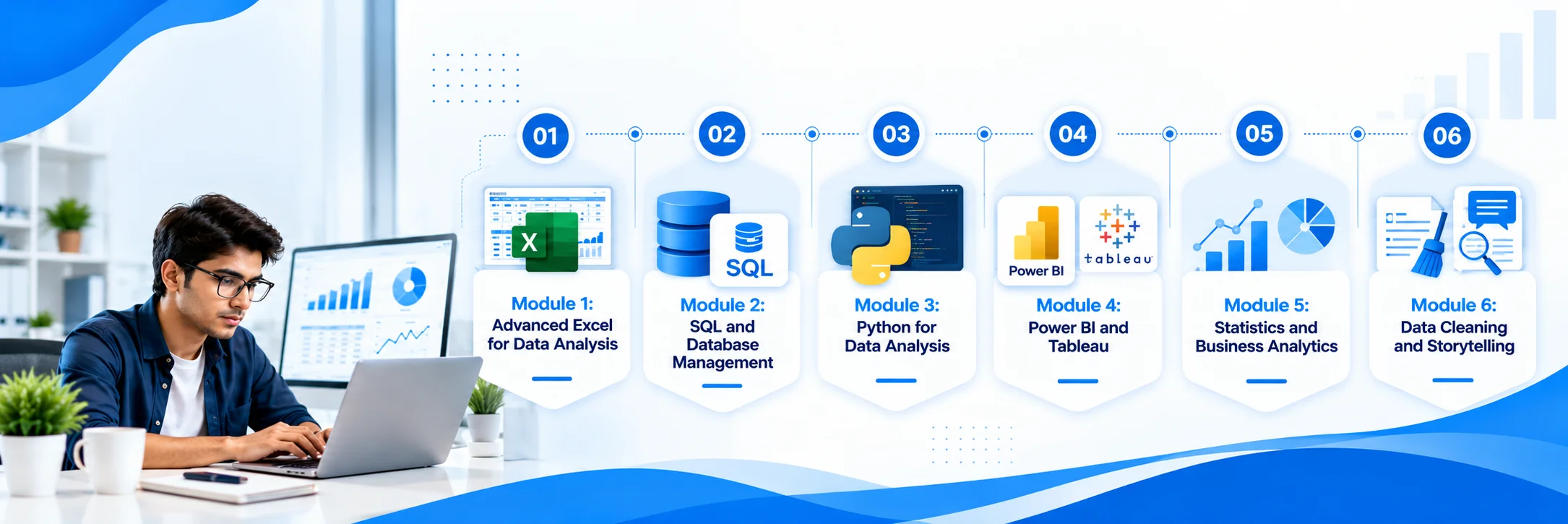
A solid data analyst course syllabus starts with data analytics tools for beginners and ends with real projects. Six modules matter most.
Module 1: Advanced Excel for Data Analysis
Excel is where most analysts begin. It is the easiest of the data analytics tools for beginners and handles daily reporting work.
- Lookup formulas like VLOOKUP and XLOOKUP to match data across different sheets quickly.
- Logical and text functions that clean and sort messy entries without manual retyping.
- SUMIFS and COUNTIFS to total data by region, month or product.
- Pivot tables that turn thousands of rows into a clear summary in minutes.
- Charts and conditional formatting to make numbers easy to read at a glance.
- Power Query for combining and cleaning files from different sources automatically.
Module 2: SQL and Database Management
Most business data lives in databases, not spreadsheets. SQL lets you pull exactly the data you need and nothing extra.
- Database basics, including tables, rows, columns and how they connect to each other.
- SELECT, WHERE and ORDER BY to fetch and sort specific records.
- GROUP BY and aggregate functions to count, sum and average data by category.
- JOINs to combine data from two or more tables into one result.
- Subqueries and CTEs to solve multi-step questions in cleaner, readable queries.
- Creating, updating and managing tables safely in a database like MySQL.
Module 3: Python for Data Analysis
Python handles tasks that are too big or too repetitive for Excel. You do not need a coding background to start.
- Python basics like variables, loops and functions, taught slowly with simple examples.
- Pandas for loading, filtering, sorting and summarising large datasets.
- Jupyter Notebook for writing code, running it and showing results in one place.
- Reading data from Excel, CSV and databases directly into Python.
- Cleaning missing values, duplicates and wrong data types with a few lines of code.
- Basic charts to spot patterns and outliers quickly.
Module 4: Power BI and Tableau
Reports nobody understands are useless. These two tools turn raw numbers into interactive dashboards that managers actually use every week.
- Connecting Power BI to Excel files, databases and web data.
- Cleaning and shaping data in Power Query before building any visual.
- DAX basics to create measures like total sales, growth and running totals.
- Building charts, maps, cards and slicers that respond when users click.
- Designing a clean dashboard layout that fits one screen and tells one story.
- Tableau basics, including worksheets, dashboards and filters, so you can work in either tool.
Module 5: Statistics and Business Analytics
Numbers mean little without context. Statistics helps you judge whether a pattern is real, and business analytics links it to decisions.
- Mean, median, mode and standard deviation to describe any dataset in simple terms.
- Probability basics to understand risk, chance and expected outcomes.
- Correlation to see which factors move together, and why that is not always cause.
- Hypothesis testing and A/B tests to check whether a change really worked.
- KPIs and business metrics such as revenue, churn, conversion and profit margin.
- Basic forecasting and trend analysis to plan sales, stock and budgets.
Module 6: Data Cleaning and Storytelling
Analysts spend a big part of their time cleaning data, then explaining results. Both skills matter in every interview.
- Finding and fixing missing values, duplicates, spelling mistakes and wrong formats.
- Validating data with simple checks so reports stay accurate month after month.
- Handling outliers and deciding when to remove, fix or keep them.
- Choosing the right chart for the right message, instead of the fanciest one.
- Writing a short summary that explains what happened, why, and what to do next.
- Presenting findings to non-technical people using simple words and clear visuals.
- Building a portfolio project from raw data to final presentation.
At Data Skill Hub, the Data Analytics with AI program follows this same path, from Excel to Power Query, Power BI, SQL, Python and GenAI, with real corporate projects. Ask any institute for its full syllabus before you pay.
Career Opportunities After a Data Analyst Course in Pune
The data analyst career opportunities in Pune span IT firms, banks, startups and manufacturers. If you are planning to start a career in data analytics, understanding these five roles can help you choose a suitable career path.
- Data Analyst: Collects, cleans and studies data to answer business questions, then shares findings through reports and dashboards. It is a natural first role after the course.
- Business Analyst: Works between business teams and data. You study processes, find problems and suggest fixes backed by numbers, so SQL, Excel and clear communication all matter.
- MIS Executive: Prepares daily and monthly reports for managers. Excel, pivot tables and dashboards are your main tools, and automation skills help you stand out.
- Reporting Analyst: Builds regular reports and dashboards in Power BI or Excel, checks that the numbers are correct, and updates them as data changes.
- BI Developer: Designs dashboards and data models that whole teams use. This role usually asks for stronger Power BI, DAX and SQL skills, so it suits learners who keep practising.
Look for data analytics courses in Pune with placement support, so you get help with resumes, mock interviews and employer connections.
What can improve your earning potential?
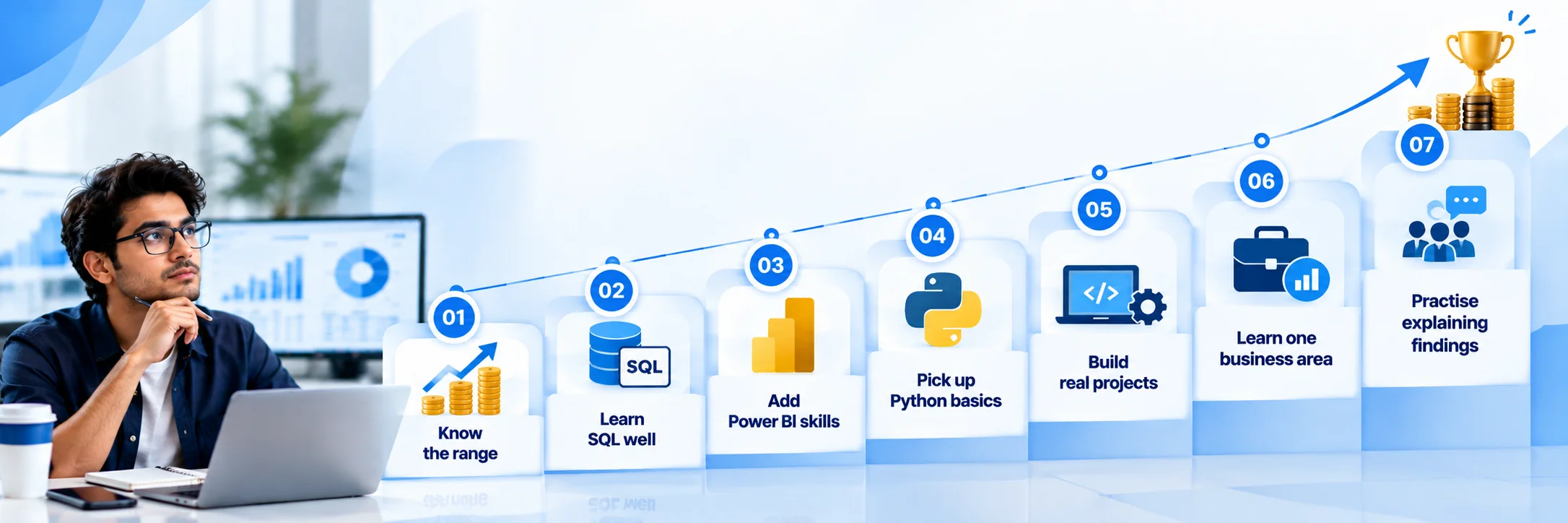
- Know the range: Listings put data analyst pay in Pune at about ₹4 to ₹10 LPA, although actual earnings vary by experience, skills and employer. Read more about data analyst salary to understand the factors that influence your earning potential.
- Learn SQL well, because it comes up in many analyst interviews and shows you can work with real databases.
- Add Power BI skills, since dashboards are something managers can see and judge you on straight away.
- Pick up Python basics to handle data that is too big or too repetitive for Excel.
- Build three or four real projects and show them on LinkedIn or GitHub, with the problem, your steps and the result.
- Learn one business area, such as finance, retail, healthcare or HR, because understanding the business makes your analysis more valuable.
- Practise explaining findings in simple words, since good communication can matter as much as technical skill.
How to Choose the Best Data Analyst Institute in Pune
Plenty of institutes offer data analytics training in Pune, but quality varies. Check these seven points before you pay a rupee.
- Trainer experience: Ask who teaches. A working analyst explains with real business examples, not only slides.
- Live practice: Pick live, hands-on classes with assignments over pre-recorded videos alone.
- Syllabus coverage: Check that it covers Excel, SQL, Python and Power BI, with enough hours for each tool.
- Real projects: Look for projects on real business data, because they matter more than the certificate in interviews.
- Certification: A data analyst certification in Pune should be verifiable. Ask if employers can check it online and which bodies the institute is affiliated with.
- Placement support: Any of the data analytics courses in Pune with placement should tell you exactly what you get, such as resume review, mock interviews and employer connections. Be careful with 100% job guarantee claims.
- Demo and fee details: Attend a free demo first, and get the full fee, EMI terms and any extra charges in writing.
Data Skill Hub offers live classes by a Microsoft Certified Trainer, real corporate projects and a free demo. Try a session first.
Conclusion
Data skills are no longer only for IT people. Accountants, marketers, HR teams and business owners all use them now. The right data analyst course in Pune gives you a clear path, from Excel basics to dashboards, SQL and Python, with real projects to show for it.
Compare fees, syllabus and support, not just price. Then see the teaching for yourself. Book a free demo class at Data Skill Hub. Your first dashboard could be closer than you think.