Ever wondered how companies like Flipkart, Swiggy and Zomato make smart business decisions every single day? The answer is Data Analytics — and right now it is one of the hottest and highest paying careers in India. Fresh graduates, commerce students and working professionals are all successfully switching to data analytics completely from scratch. The demand is huge, salaries are strong and opportunities are growing every single day across every industry in India.
The good news is — you do not need a technical background or coding experience to get started. In this blog we will walk you through exactly what data analytics is, what skills you need and a complete step by step roadmap to go from zero to job ready in just 6 months. Let’s get started.
What is Data Analytics?
Data analytics is simply about making sense of the data you already have. You collect it, clean it up, organize it properly, and then look for patterns that tell you something useful. It helps people and businesses stop guessing and start making decisions based on what the numbers are actually saying — whether that means solving a problem, improving performance, or hitting a business goal faster.
Data is everywhere today. Every startup, every bank, every e-commerce company — they are all collecting massive amounts of data daily without even realizing how much. But data alone means nothing until someone organizes it and finds the story inside it. That is the real job of a data analyst — cutting through all the noise and giving businesses the clear answers they need.
Why Choose Data Analytics as a Career?
Data Analyst is considered to be one of the most promising careers when it comes to career opportunities. Every company uses data as an important part of making good business decisions. This results in high demand for skilled data analysts.
Data analyst is one of the careers where one can receive a good salary package and many other career opportunities. There are also many fields where one can work like finance, health care, e-commerce, marketing, and information technology.
Top Skills Required to Become a Data Analyst
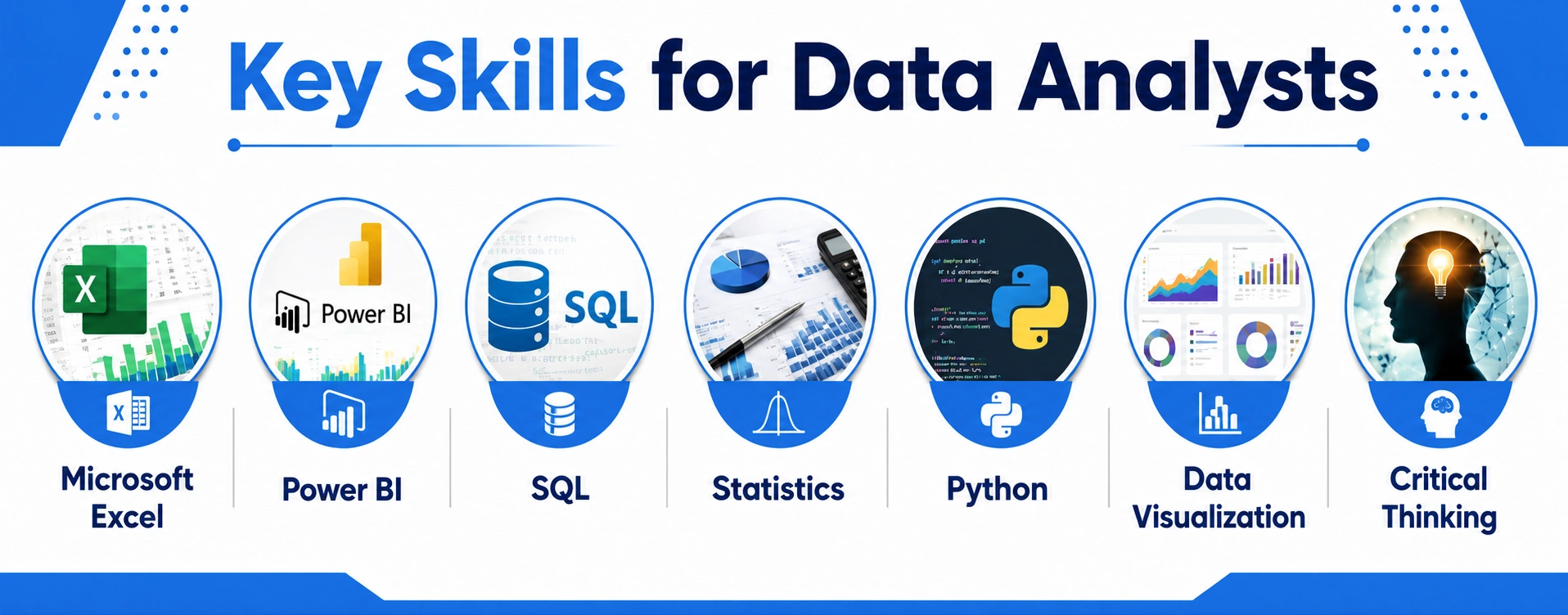
If you want to become a job-ready data analyst, you need to build the right skills in the right order. Here are the 7 most important skills every beginner must learn.
- Microsoft Excel – Excel is where every data analyst begins. It covers VLOOKUP, PivotTables, dashboards, and data cleaning. Almost every Indian company still uses Excel daily, making it an essential and immediately useful skill. If you’re new to Excel, joining a structured Excel course can help you build a strong foundation through practical exercises and real-world projects.
- Power BI – Power BI helps you build interactive dashboards that show business performance clearly. It connects multiple data sources and turns complex numbers into simple visuals—one of the most in-demand skills in India right now. If you want to build this skill professionally, enrolling in a practical Power BI course can help you learn dashboard creation, DAX, data modeling, and real-world reporting through hands-on projects.
- SQL – SQL lets you directly access and manage databases. You can extract, filter and sort large data within seconds. Almost every data analyst job in India requires SQL — and it takes just 4 to 6 weeks to learn.
- Statistics – Statistics helps you understand what numbers are actually saying. Concepts like mean, median, correlation and trend analysis help you spot hidden patterns. You do not need to be a maths expert — basics are enough.
- Python – Python is not mandatory at the start but gives you a serious advantage. It helps clean large datasets, automate tasks and perform advanced analysis. Libraries like Pandas, NumPy and Matplotlib make your work faster and smarter.
- Data Visualization – Analyzing data is only half the job — presenting it clearly is the other half. Whether using Power BI, Tableau or Excel charts, your goal is always the same — make data simple and impossible to ignore.
- Critical Thinking – No tool can teach this skill — but it separates good analysts from great ones. Asking the right questions before opening a spreadsheet — like why sales dropped or which product is performing best — is what makes you truly valuable.
How to Become a Data Analyst: A Step-by-Step Roadmap
You now know what skills are needed. But how exactly do you go from zero to job-ready? Here is your complete beginner roadmap for data analytics — step by step.
Step 1: Learn the Fundamentals
Every data analytics journey starts with the basics — and that is exactly where you should begin. Start with Microsoft Excel to understand data handling. Then move to basic statistics to understand numbers. Then learn SQL to work with databases. Do not rush this phase. Many beginners make the mistake of jumping straight to Python without building this foundation first. A strong foundation in these three tools will make everything else much easier to learn later.
Step 2: Practice Every Day
Learning theory is not enough — you have to practice every single day to actually build real skills. Aim for at least 2 to 3 hours of daily practice on real datasets. Use free platforms like Kaggle for datasets, HackerRank for SQL challenges and YouTube for Power BI tutorials. Consistency matters more than speed. Even 30 days of daily practice will give you more confidence than 6 months of on-and-off learning.
Think of it like going to the gym — results come only with regular effort.
Step 3: Build Projects
The projects are the most effective method of applying what you have learned. Get your hands dirty working with real data and build projects such as sales dashboard, customer analytics reports, etc. using Excel, SQL, Power BI, and Python. These projects will not only prove your skills but also enhance your problem-solving abilities.
Step 4: Create a Portfolio
Your portfolio is your biggest weapon when applying for your first data analyst job with no experience. It proves your skills even when you have zero work experience. Build at least 4 to 6 complete dashboard and Python projects. Add them to GitHub and create a simple LinkedIn profile that showcases your work. Remember — recruiters spend only 6 to 7 seconds scanning a resume. A strong portfolio gives them a reason to stop and look at yours longer than anyone else’s.
Step 5: Earn Relevant Certifications
Certifications signal recruiters how serious you are about your career. If you’re new to the field, the Google Data Analytics Professional Certificate is your ideal first step: It’s widely recognized, easy to get into, and it puts you in touch with 130+ companies that hire professionals like you. The Microsoft PL-300 certification is the industry standard for Power BI. In a survey of 111 hiring executives, it was revealed that employers prefer candidates with both practical skills and a recognized certificate, rather than just having a certificate.
Step 6: Learn Business Communication
This step is something most beginners completely ignore — and it is a big mistake. Technical skills get you the interview. Communication skills get you the job offer. A data analyst who cannot explain their findings clearly to a non-technical manager is not truly job-ready. Practice presenting your dashboards and projects out loud. Learn to tell a clear data story using PowerPoint. Work on your email communication. These soft skills will make you stand out in every single interview you attend.
Step 7: Apply for Entry-Level Jobs
Once your resume is ready, start applying immediately. Target roles like Junior Data Analyst, MIS Executive, or Reporting Analyst on Naukri, LinkedIn, and Indeed daily. Customize your resume for every job — never send the same one everywhere. Connect with data professionals on LinkedIn. Your first job may be small, but it starts everything.
Also Read: Data Analytics vs Data Science: Which Career Is Better in 2026